exointelligence and cosmic art
The search for extraterrestrial intelligence is a response to a question now in the public
domain: «In addition to our intelligence, are there other intelligences in the cosmos?»
The affirmative response presented here makes it possible:
- to observe the artistic-visual aspect of these intelligences through finds identified by remote satellite sensing performed by the international space agencies on the celestial bodies of the Solar System;
- to measure the finds observed so as to determine their size and identify the coordinates to recognise the places where they are located;
- to verify the repetition of the intentional patterns that distinguish the artistic compositions identified that can allow the formulation of pondered hypotheses on the technological and cultural capacities of these intelligences.
Some innovative archaeologists, as Sarah Parcak of the University of Alabama, recently have developed their archaeological research using the new remote sensing technology with excellent results1. Also in the research that is summarily presented here many findings have been sighted by analysing very numerous remote sensed images. The observations made it possible to note that many figures of heads are represented on the surface of the celestial bodies of the Solar System. How can it be that the terrain of the celestial bodies and the traces excavated from many rivers together with the outlines of many coasts present such morphologically defined structures? And how is it possible that these figures also appear where there are no rivers and reliefs? The simplest answer is that they are there purely by chance.
By observing these figures in more detail it is possible to find out artistic compositional patterns that are repeated: truncated neck, image within an image, intersecting faces and so on. These signs, often superimposed on each other, sometimes make it difficult to have an overview of what has been represented, but once recognised they are so convincing as to then be interpreted as artistic finds, as happens for the finds recovered on the walls of Tassili in the Sahara Desert, for the finds in the caves of Lascaux, and for the graffiti of cave art on the mountains of half the world and particularly in the Camonica Valley.
Nevertheless, there is one difference that is not negligible: the finds discovered in this research are so enormous as to not able to be created by members of any terrestrial civilisations so far known and the content represented does not refer to moments of human history.
The difficulties encountered during the research, constantly under way for over fifteen years now, have been of various kinds: from finding the scientific documents, which had to be exclusively of origin guaranteed by the international space agencies, to their cultural interpretation, which led to investigate the most controversial aspects through the analyses conducted by Gestalt psychology2 and by the recent investigations conducted by the neurosciences on ambiguous images3. But the greatest difficulty has been and still is that of having the remote sensed scientific documents observed from a new point of view by a prejudicially sceptical interlocutor, someone unwilling to suspend at least temporarily their usual way of observing reality.
This attitude, during the course of history, has often ignored or challenged many of the insights that have proven to be more correct than others4 during the course of the centuries.
After all, the cultural and scientific community took hundreds of years to accept the heliocentric theory of Nicolaus Copernicus, the insights into infinite worlds of Giordano Bruno and the observations of Galileo Galilei using a technological instrument.
At the dawn of the third millennium it is possible to constater that decades have gone by since the SETI group (Search for Extra-Terrestrial Intelligence) began to pursue the objective of discovering whether we are alone in the Cosmos.
Yet the investigations conducted until now with radiotelescopes have proven barren. Why have positive results not been achieved? To answer this question it's necessary to remind that from a theoretical point of view the SETI research is based on probabilistic calculations accepted as hypotheses by the international scientific community, such as the famous Drake equation5.
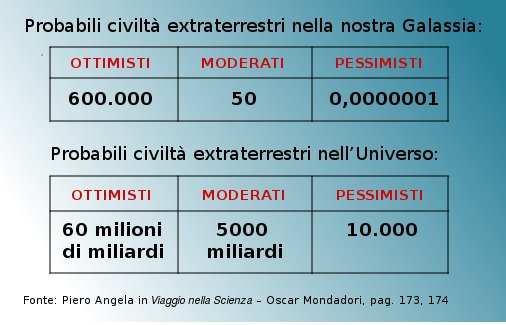
With radiotelescopes and with a great deal of patience and accuracy scientists consider that they can succeed in establishing a «contact over great distances» with probable extraterrestrial civilisations.
Today the scientists, by using space telescopes, are able to state that "the number of confirmed planets exceeded 5000 and there are thousands of other candidates to analyze, so that astronomers have concluded that every star in the galaxy has its own planetary system".
Ihypothesizing that other civilisations exist in the Cosmos that have had some evolutionary periods different from our own and that could have made exploratory journeys in the cosmos in the distant past, as we are doing now, allows us to start a search on our planet and the planets of the Solar System for the signs of extraterrestrial intelligence left by these hypothetical explorers.
If what is necessary to look for are signs of intelligence, then it is needed first of all to define at least synthetically this concept.
The studies of J. Piaget, one of the most famous experts in genetic psychology and S. Bruner, one of the most famous experts in cognitive psychology, agree in considering intelligence a form of adaptation. They specify, in short, that it is a process similar to the biological model of the relationship between organism and environment, which develops in three phases:
- Assimilation of patterns, representations, emotions and concepts present in the environment;
- Accommodation of known knowledge;
- Responses appropriate to the problems to be resolved.
The psychologist Howard Gardner has proposed the concept of multiple intelligences, distinguishing 7 types of intelligence: logical-mathematic, linguistic, spatial, musical, kinesthetic, interpersonal and intrapersonal 7. While anthropologist Pierre Levy looked forward to the birth of a collective intelligence, through the highways of telematic information: «an intelligence distributed anywhere, continually enhanced, coordinated in real time, leading to a genuine mobilisation of skills»8.
Likewise palaeontologist Teilhard de Chardin considers that the whole of humanity is evolving towards the Noosfera9, a kind of planetary intelligence.
One thing is certain and agreed: the civilisations that have evolved on our planet are evident signs of this evolutionary process of individual and collective intelligence, testified to by archaeological finds, by cultures and by technologies.
The radio signals transmitted by radiotelescopes are signs of terrestrial intelligence, as are the amygdule displayed with pride by a naturalist, the painting of The Last Supper by Leonardo da Vinci, the architectural structures and all the technological objects, such as a computer or an artificial satellite that orbits our planet, and so on. When we launched the probe Pioneer 10 into space, we earthlings were keen to send a plate containing a scientific message and an artistic message in which the images of two examples of our species were much in evidence: a male and a female.
If we behaved in this intelligent way, can we rule out that other intelligences in the cosmos, in remote times, behaved in a similar way? Now if one or more cosmic civilisations visited our planet in the distant past, they may have left some signs of their passage, just as we are leaving them with the exploration of the cosmos. According to physicist Paul Davies «it could even be an artistic, cultural or religious symbol, or even the cosmic equivalent of graffiti»10. With the advent of astronautics and with the new instruments of remote satellite sensing these «intelligent» signs have now been discovered, observed, measured and interpreted.
The cosmic civilisations that preceded us have left (intentionally or not) artistic signs that represent their effigies. Those who do not see them can now analyse and measure the results of this research. Those who do not want to see them are probably people who cannot admit that civilisations can exist with a more advanced or different evolutionary development from that of the Earth. Such behaviour is similar to that of the contemporaries of Galileo Galilei, who refused to observe reality through his telescope, because it is always too painful to admit that what has always been thought can be placed in doubt.
The scientific, human, social and religious implications of this discovery concern vast fields of knowledge in which nobody can be fully competent. So, why not combine all the skills to take a further step forward together?
With this intention I must highlight that German Catholic theologian Armin Kreiner, lecturer at the University of Munich, in a recent book11 expounded the theological arguments that make Christian faith compatible with possible extraterrestrial life.
1Sarah Parcak, Satellite remote sensing for archaeologyTaylor & Francis Ltd 2009
2R. Arnheim, Arte e percezione visiva, Feltrinelli 1982, pagg. 26,70,73,365
3H. Maturana, F. Varela, L’albero della conoscenza, Garzanti
4A. Tartaglia, La luna e il dito, Lindau 2009, pag. 55
5F. Drake, vedi Wikipedia: equazione di Drake
6G. F. Bignami, Le rivoluzioni dell’universoGiunti 2017, pag. 155
7H. Gardner, Formae mentis. Saggio sulla pluralità dell’intelligenza, Feltrinelli, Milano 2010
8Pierre Levy, L’intelligenza collettiva. Per un’antropologia del cyberspazio, Feltrinelli 1998, pag. 34
9Teilhard de Chardin, L’apparizione dell’uomo, il Saggiatore, 1979, pag. 279
10P. Davies, Uno strano silenzio. Siamo soli nell’Universo?, Codice Edizioni, Torino 2012, pag. 103.
11A. Kreiner, Gesù, gli Ufo e gli alieni. L’intelligenza extraterrestre come sfida alla fede cristiana, Editrice Queriniana, Brescia, 2012